Chaos to clarity, with Katalog.
CHALLENGE
People own too much, have too little time, and traditional decluttering methods demand commitment, follow-through, and emotional energy they don’t have.
SOLUTION
A mobile app that tracks daily usage, reveals invisible patterns, and delivers insights with clear and actionable steps to help user easily align their possessions with what matters to them now.
my role
UI/UX Designer & Researcher
SKILLS
User Research, Wireframing,
Prototyping
TIMELINE
Fall 2025
TOOLS
Figma, Miro
The problem
People have too much stuff, and it’s stressing them out.

The emotional weight of possessions
48% of people report feeling stress caused by clutter.
74% of Americans completed a decluttering project in the last year.

Why existing solutions fail
Decluttering methods like The KonMari Method, capsule wardrobes, and The Home Edit’s color-coding system all only provide a temporary sense of control over the items we own.
They rely on guesswork - “I might use it someday,” or “does it spark joy? ‘

The problem with guesswork
These systems fail to teach users which possessions actually support their lives. So the cycle continues:
new things are purchased, clutter accumulates, and another weekend is spent trying to regain control of the objects filling our homes.
user research
How did we get here?
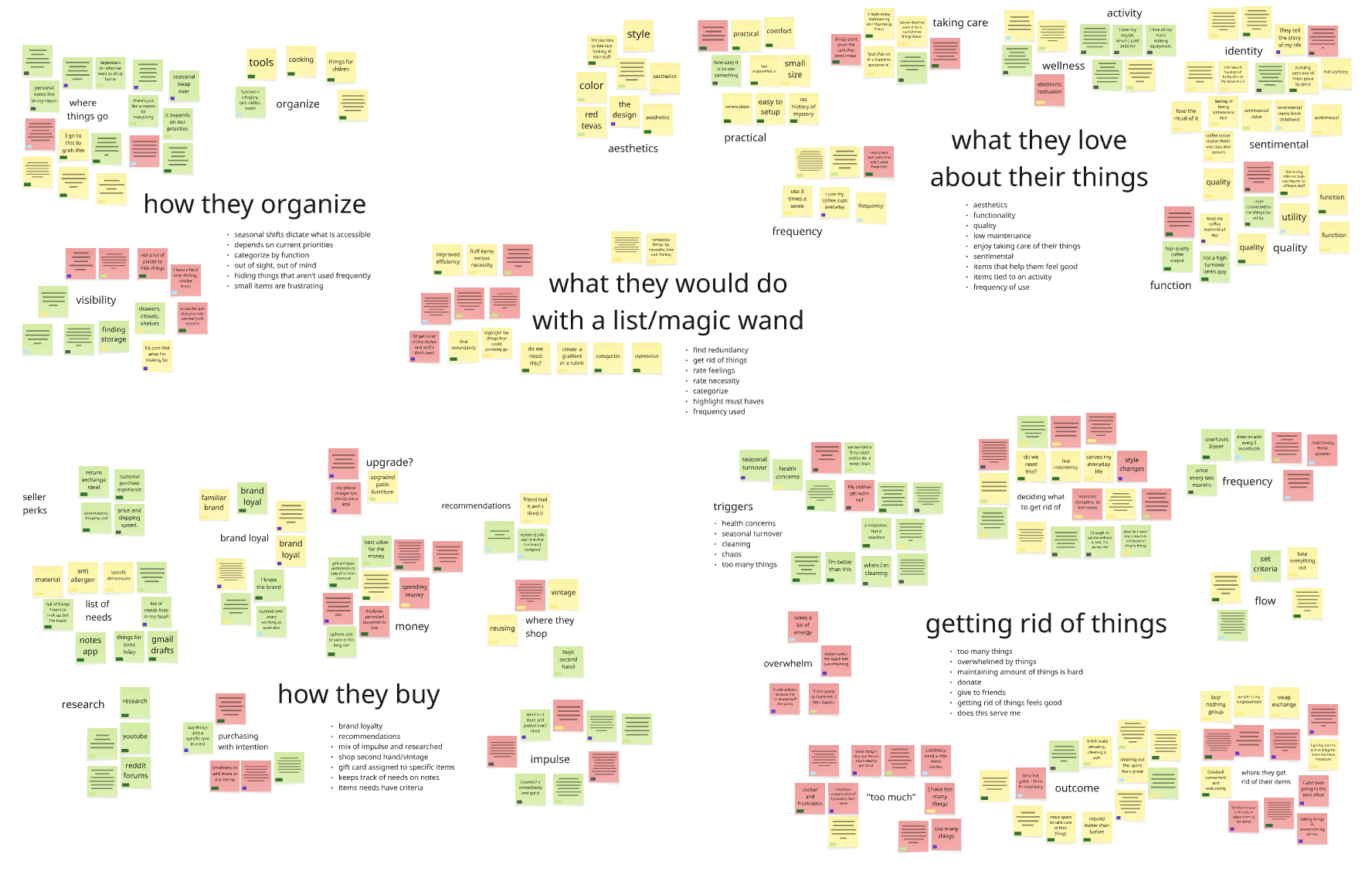
I kicked off the project with 6 individual virtual discovery interviews to learn about the relationship between people and their things.
research goals

How do people feel about their belongings as a whole?

What systems, if any, do people use to manage their belongings?

What motivates people to reassess what they keep?

What causes people to feel negatively about their belongings?

How do people assign value to items?
insights
People don’t want things they don’t use.
Priorities shift and clutter accumulates like clockwork, but organizing only happens sporadically––in long, grueling bursts triggered by maximum overwhelm––reinforcing a pattern of avoidance and negative emotions between people and their things.
People want continuous order—but only declutter reactively, when the chaos becomes overwhelming.
“it’s a reaction to an overwhelmed feeling, like I'm tired of tiptoeing around the chaotic busyness in the house.”
They don’t want to hold onto unused items—but the time and energy it takes to decide what to get rid of prevents them from acting.
“I just want the decision made for me to minimize my things based on what I'm actually using”
Priorities shift—but people lack systems to adjust their belongings accordingly.
“Eventually my room will have too many things that I don't use anymore or that just don't allow for quick access.”
key persona
Meet Do-It-All Dora
With these insights, I identified our key persona: Do-It-All-Dora, a busy, outdoor enthusiast who loves to experiment with her style––but struggles to manage the belongings that help her do it all.

Dora, 30
Location: Portland, OR
Job: Marketing
Home: Rents 1 bedroom apartment with partner
INTERESTS
camping
cycling
thrift shopping
fashion
cooking
hosting dinners
hiking
skiing
“There are some things I absolutely love, but there’s a lot I need to get rid of. I feel like I'm constantly just bursting at the seams because I'll also buy new things, too”
GOALS
Maintain an organized, functional living space
Keep only items that serve her current lifestyle
Spend weekends enjoying hobbies, not decluttering
NEEDS
A system that adapts to her changing priorities
Quick, non-disruptive way to know what she needs accessible
Clear guidance on what to keep vs. let go
MOTIVATIONS
Wants her space to reflect who she is now, not who she was
Values intentional living and sustainability
Desires mental clarity that comes with physical order
FRUSTRATIONS
Decluttering feels like a never-ending cycle
Feels like her home is bursting at the seams
Can't tell which items truly serve her
Feels guilty about unused purchases
Opportunities
How might we help users effortlessly maintain alignment between their belongings and their current needs?
After identifying key insights, I defined three opportunities to explore:
How might we make decluttering feel effortless?
How might we help users maintain order continuously?
How might we align users’ current needs with what they keep?
potential solutions
What if Dora could keep track of what she used, so she could know what to keep with confidence?
I drafted early wireframes for three potential solutions to test with participants:
A SIMPLE SWIPE
Making decluttering effortless.
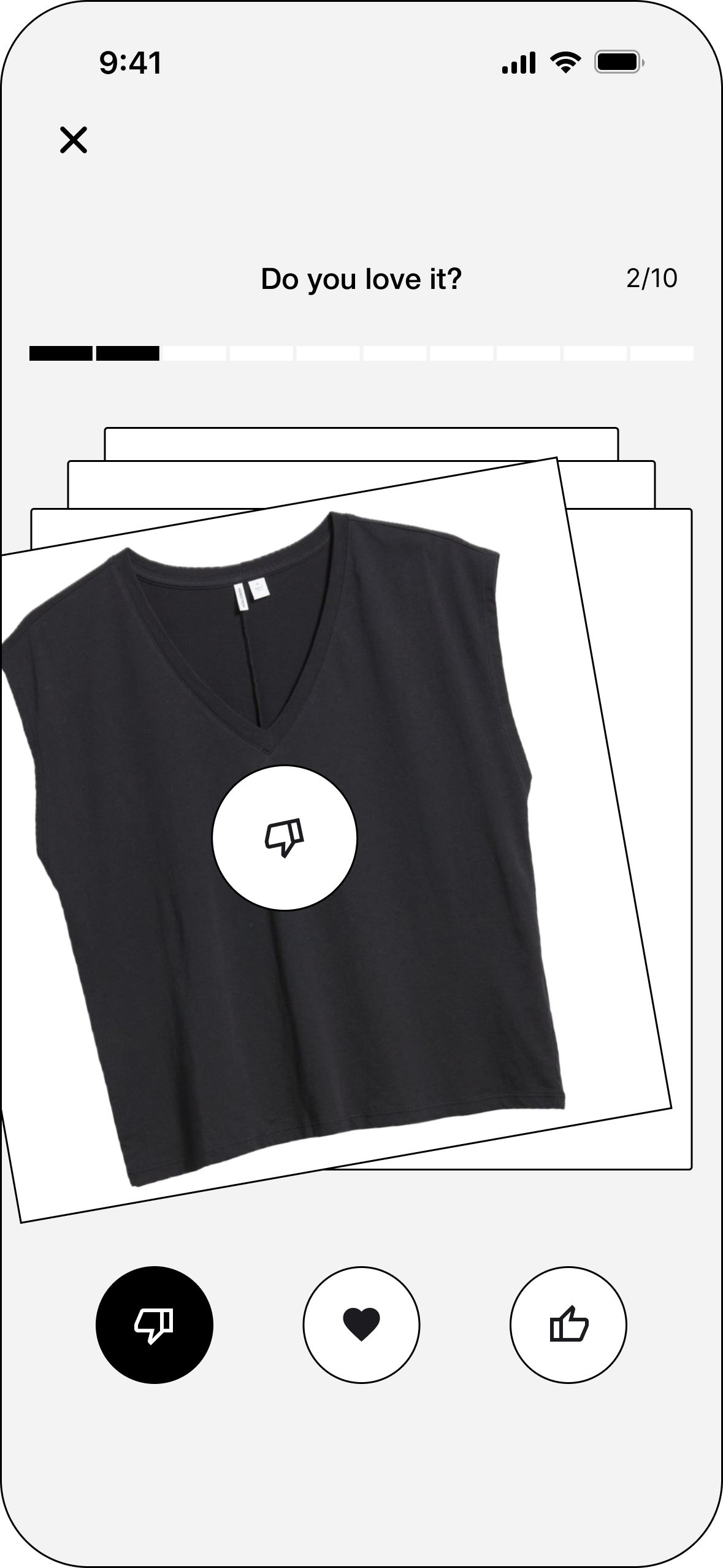
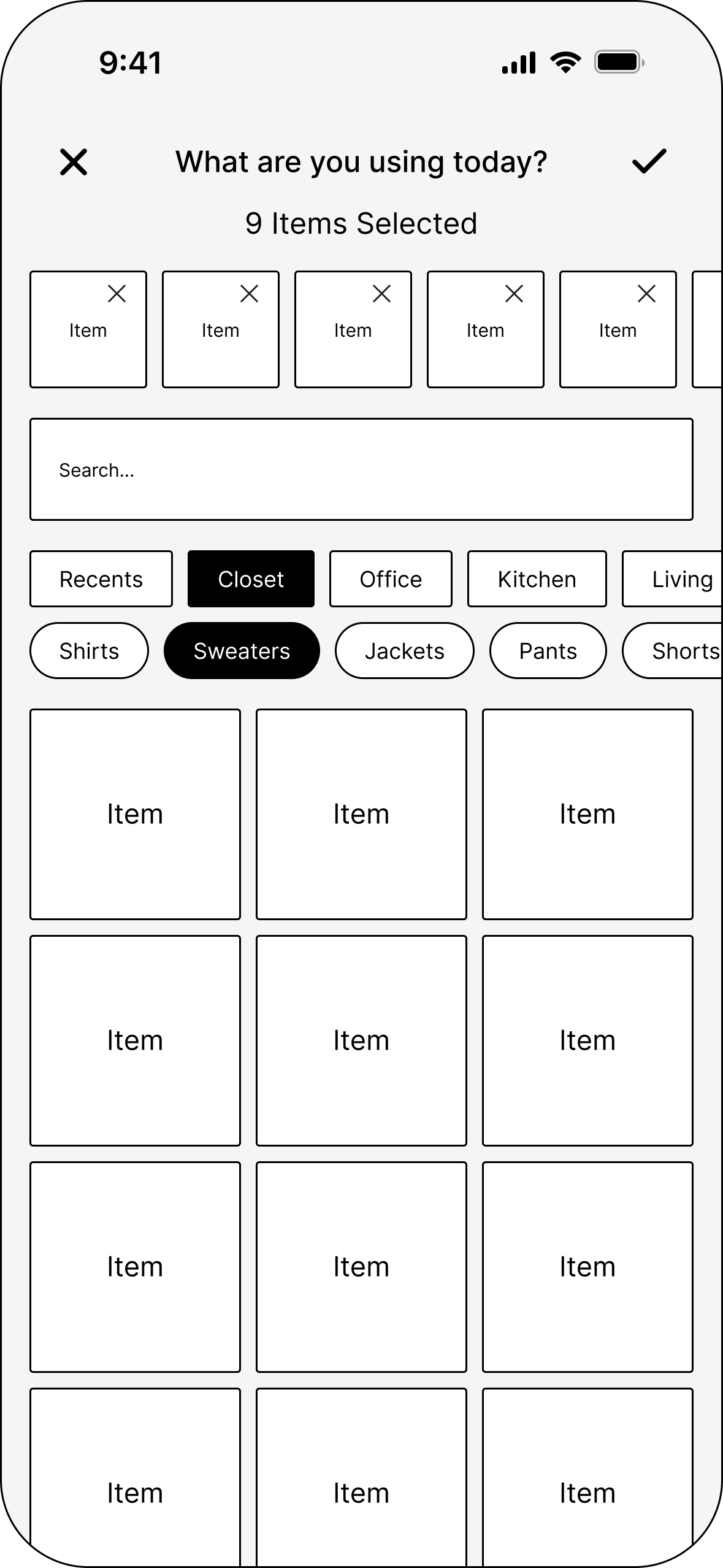
Users simply swipe to sort items into 3 groups: discard, favorites, and keep—allowing them to declutter anytime, anywhere, without dedicated time blocks.
DAILY USAGE LOG
Maintaining order continuously.
Users track which belongings are actually serving them based on what they’re using, while simultaneously surfacing what isn't—turning daily behavior into visible data that shows them what they really need.
YOUR INSIGHTS
Aligning belongings with current needs.
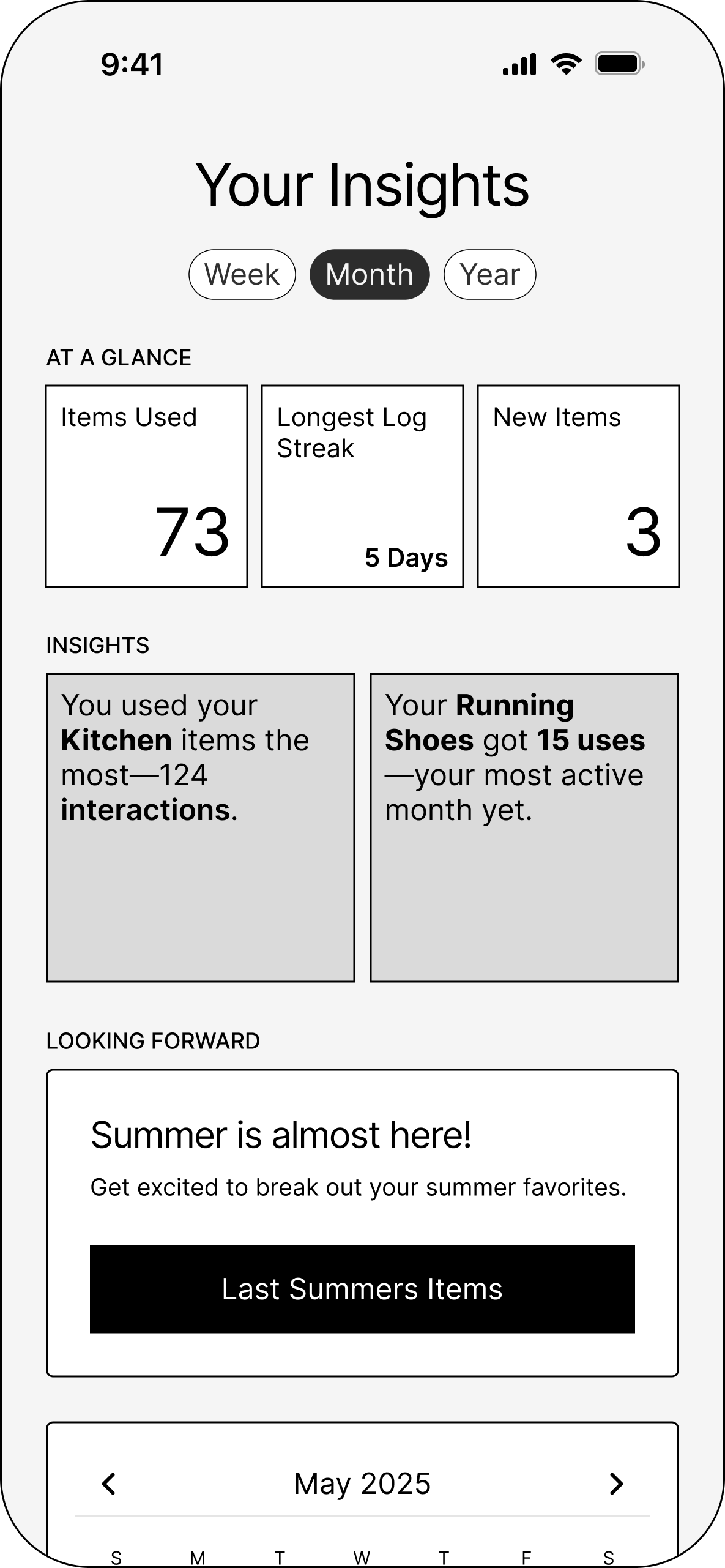
Based on data from the Daily Usage Log, users get a clear snapshot of which belongings actually power their lives and when—making invisible usage patterns clear and visible.
USER Feedback
Users need a solution that integrates seamlessly into daily life––while bridging the gap between insight and action.
While participants found the visualizations eye-opening and appreciated seeing their real behavior, three key concerns emerged:
Unclear path to action.
Users didn't understand how digital sorting translates to physically getting rid of their belongings.
“I like how easy it is to swipe through my things, but the clothes will still be sitting there in my closet.”
Logging friction.
Manual logging felt overwhelming, forgettable, and unclear (which items should I log?).
"Constantly having to log feels like homework, and I don’t think I’d be able to remember everything I used at the end of the day."
Insight without guidance.
Powerful insights didn't translate into clear next steps.
"It’s eye-opening to see actual behavior clearly laid out like this, but I don’t know what I’m supposed to do with it."
key learnings
The solution needed to:
Minimize logging effort––so that people don’t have to remember what they used all at once.
Clearly connect digital insights to physical decluttering actions.
Provide specific, actionable steps–– beyond just showing data.
refinED solution
Katalog is designed for people drowning in possessions and starved for time.
overview
Katalog eliminates the overwhelm of traditional decluttering by seamlessly integrating into users’ existing routines—no dedicated sessions, no exhausting decisions.
In just a few minutes throughout the day, users log what they actually use. Over time, Katalog reveals what they don’t.
By requiring minimal time and attention, Katalog delivers impactful insights and clear, actionable steps that help users align their belongings with what truly matters to them right now—so they can take back control of their homes and their lives.
Key features
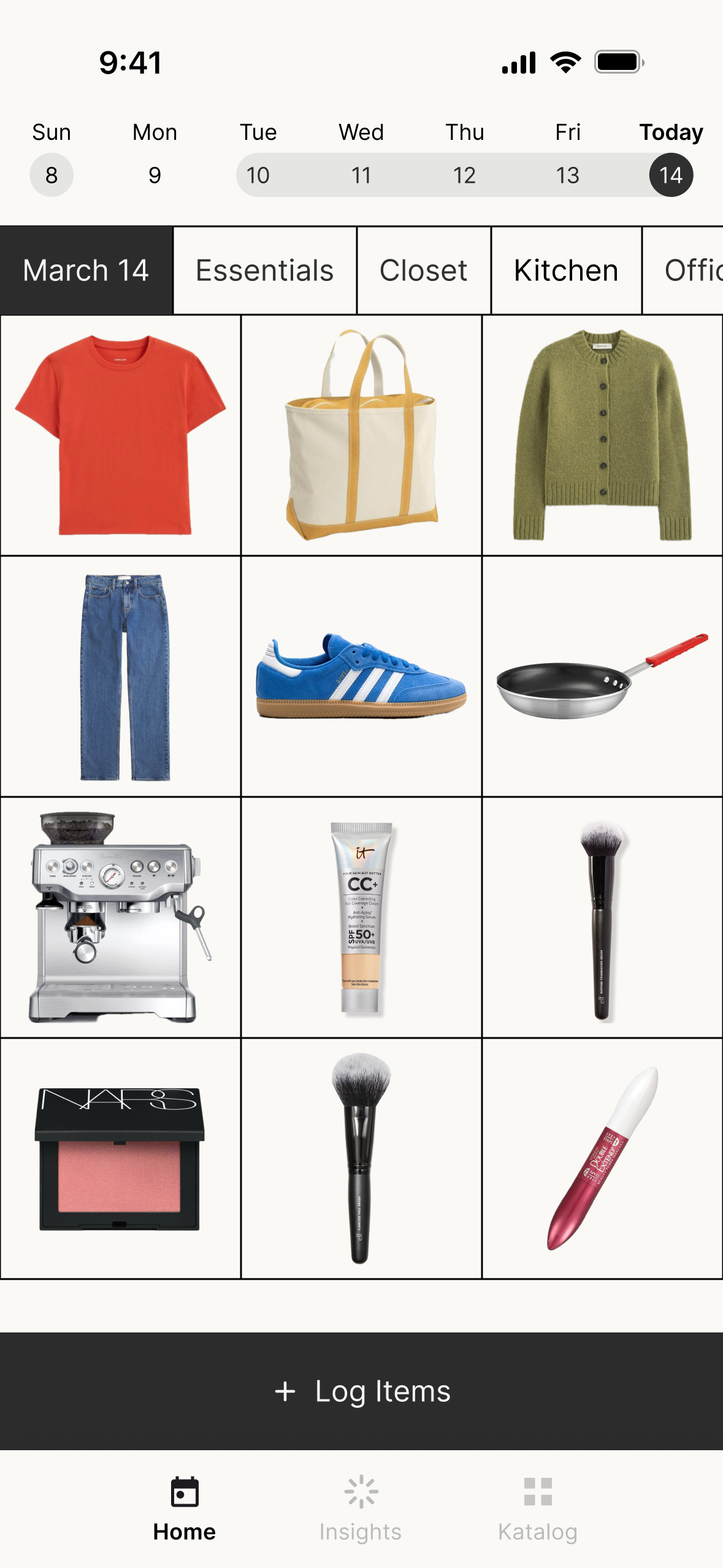
- Quick Logging: Users spend just 1–5 minutes a day logging what they’re using, receiving multiple check-ins throughout their day.
- Personalized Notification Timing: If someone consistently logs at 10am once they've sat down at their desk, and at 8pm after dinner, notifications automatically adapt to their rhythm.
- Digital Catalog: Items are added to a visual catalog and organized by room, category, and frequency of use––so users can log items with a simple tap.
- Quick Add: Users can add new items mid-log with no interruption to their flow. Katalog reminds them to add a photo and details afterwards.
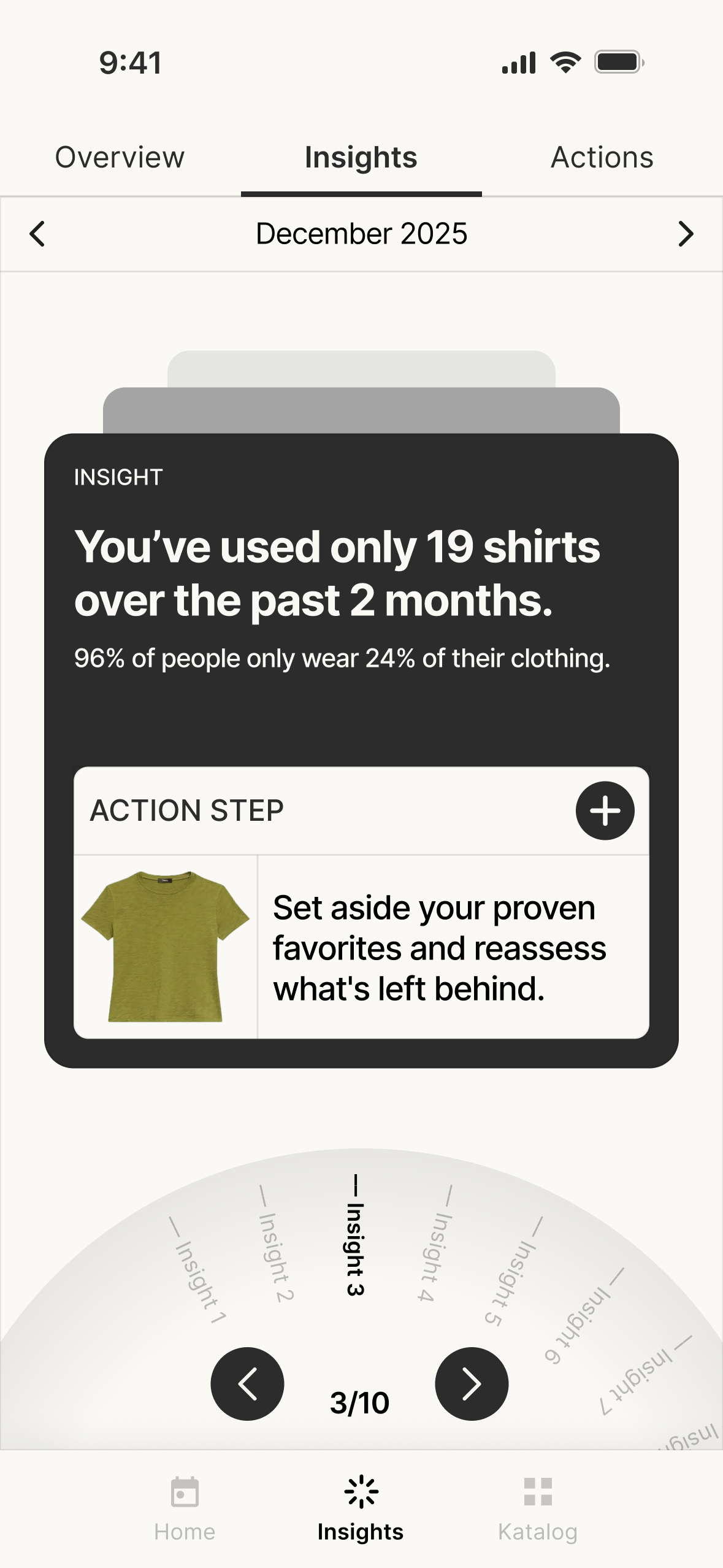
- Your Insights: Daily logging transforms into meaningful insights, uncovering patterns users didn’t know existed.
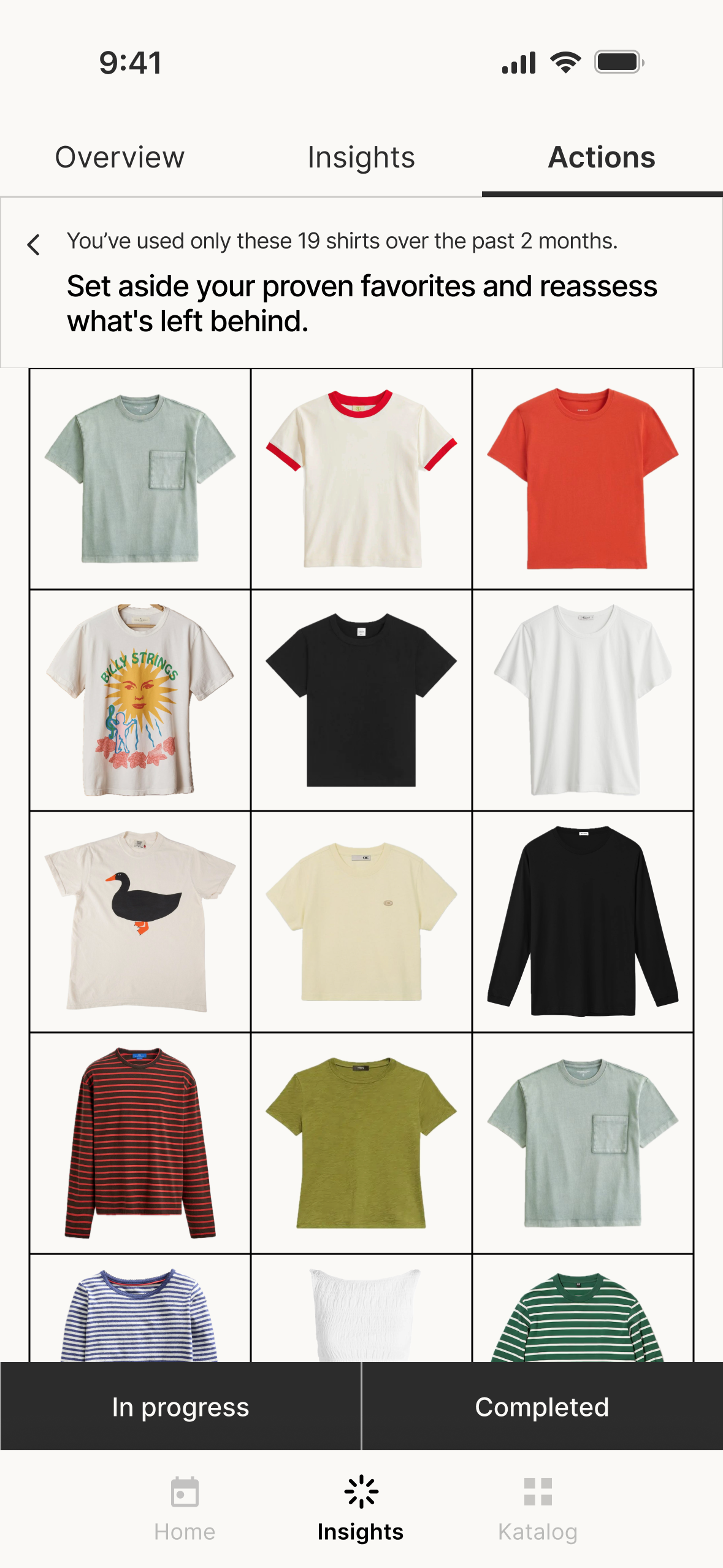
- Action Steps: Recommendations for improvement are provided with each insight, to help users decide what to keep, move, store, or let go of.
- Future Forecasting: Katalog anticipates the upcoming month based on past usage patterns, helping users prepare for seasonal shifts, lifestyle changes, and upcoming needs.
Usage Logging
Users receive multiple check-ins throughout their day at times that adapt to their schedule, spending just 1-3 minutes capturing what they're using as they’re using it, so they don't have to remember everything at once.
Everyday Essentials
Items frequently used together (makeup, coffee routine, etc.) can be added together with a single tap, acknowledging the difference between routine essentials and daily variables.
Your Insights
Uncover invisible patterns of what you’re really using, and get targeted recommendations for how to align your physical space.
Action Steps
Katalog transforms insights into specific, manageable Action Steps that shift organizing from an overwhelming project into a series of small, actionable moments.
next steps
Reflections for the future.
The disposal gap is just as important as the discovery gap
I focused heavily on surfacing unused items but less on what happens next. How might partnerships with donation services, resale platforms, or local buy-nothing groups turn insights into immediate action?
From reactive decluttering to proactive purchasing
Usage data could transform not just what users keep, but what they buy. How might Katalog shift users from impulse buying to intentional consumption, reducing waste before it enters the home?
Logging needs to feel invisible
What if logging happened automatically through smart integrations—location services, photo recognition, or connected devices—removing the burden entirely?
Final thoughts
I don't believe this solution is the final answer. However, I'm obsessed with the problem and excited to keep going.
Every test teaches me something new, and I'm determined to keep testing, iterating, and refining to find what really works.
Katalog addresses a universal frustration: the gap between wanting less and having less.
By shifting decluttering from guesswork to data-driven decision-making, it empowers users to create spaces that truly reflect their current lives—not aspirational versions of themselves or who they used to be.
The real innovation isn't just in tracking usage—it's in revealing the invisible.
When people can finally see their actual behavior rather than their imagined needs, the decision about what to keep becomes obvious. And when those decisions feel obvious rather than agonizing, maintaining order stops being a weekend project and becomes a natural part of life.
Back to Top
I love feedback
How could this case study be better?
Thank you for taking the time to explore my work. I’m always eager to learn from different perspectives and would appreciate any feedback you’re willing to share using the Google Form below.
Google form: Katalog case study feedback
sources
(1): Budget Dumpster. Making Space: 13 Home Decluttering Trends – Declutter Survey.https://www.budgetdumpster.com/resources/declutter-survey.php
Chaos to clarity,
with Katalog.
CHALLENGE
People own too much, have too little time, and traditional decluttering methods demand commitment, follow-through, and emotional energy they don’t have.
SOLUTION
A mobile app that tracks daily usage, reveals invisible patterns, and delivers insights with clear and actionable steps to help user easily align their possessions with what matters to them now.
my role
UI/UX Designer & Researcher
SKILLS
User Research, Wireframing,
Prototyping
TIMELINE
Fall 2025
TOOLS
Figma, Miro
The problem
People have too much stuff, and it’s stressing them out.
The emotional weight of possessions
48% of people report feeling stress caused by clutter.
74% of Americans completed a decluttering project in the last year.
Why existing solutions fail
Decluttering methods like The KonMari Method, capsule wardrobes, and The Home Edit’s color-coding system all only provide a temporary sense of control over the items we own.
They rely on guesswork - “I might use it someday,” or “does it spark joy? ‘
The problem with guesswork
These systems fail to teach users which possessions actually support their lives. So the cycle continues:
new things are purchased, clutter accumulates, and another weekend is spent trying to regain control of the objects filling our homes.
user research
How did we get here?
I kicked off the project with 6 individual virtual discovery interviews to learn about the relationship between people and their things.
research goals
How do people feel about their belongings as a whole?
What systems, if any, do people use to manage their belongings?
What motivates people to reassess what they keep?
What causes people to feel negatively about their belongings?
How do people assign value to items?
insights
People don’t want things they don’t use.
Priorities shift and clutter accumulates like clockwork, but organizing only happens sporadically––in long, grueling bursts triggered by maximum overwhelm––reinforcing a pattern of avoidance and negative emotions between people and their things.
People want continuous order—but only declutter reactively, when the chaos becomes overwhelming.
“it’s a reaction to an overwhelmed feeling, like I'm tired of tiptoeing around the chaotic busyness in the house.”
They don’t want to hold onto unused items—but the time and energy it takes to decide what to get rid of prevents them from acting.
“I just want the decision made for me to minimize my things based on what I'm actually using”
Priorities shift—but people lack systems to adjust their belongings accordingly.
“Eventually my room will have too many things that I don't use anymore or that just don't allow for quick access.”
key persona
Meet Do-It-All Dora
With these insights, I identified our key persona: Do-It-All-Dora, a busy, outdoor enthusiast who loves to experiment with her style––but struggles to manage the belongings that help her do it all.
Dora, 30
Location: Portland, OR
Job: Marketing
Home: Rents 1 bedroom apartment with partner
INTERESTS
camping
cycling
thrift shopping
fashion
cooking
hosting dinners
hiking
skiing
“There are some things I absolutely love, but there’s a lot I need to get rid of. I feel like I'm constantly just bursting at the seams because I'll also buy new things, too”
GOALS
Maintain an organized, functional living space
Keep only items that serve her current lifestyle
Spend weekends enjoying hobbies, not decluttering
NEEDS
A system that adapts to her changing priorities
Quick, non-disruptive way to know what she needs accessible
Clear guidance on what to keep vs. let go
MOTIVATIONS
Wants her space to reflect who she is now, not who she was
Values intentional living and sustainability
Desires mental clarity that comes with physical order
FRUSTRATIONS
Decluttering feels like a never-ending cycle
Feels like her home is bursting at the seams
Can't tell which items truly serve her
Feels guilty about unused purchases
Opportunities
How might we help users effortlessly maintain alignment between their belongings and their current needs?
After identifying key insights, I defined three opportunities to explore:
How might we make decluttering feel effortless?
How might we help users maintain order continuously?
How might we align users’ current needs with what they keep?
potential solutions
What if Dora could keep track of what she used, so she could know what to keep with confidence?
I drafted early wireframes for three potential solutions to test with participants:
A SIMPLE SWIPE
Making decluttering effortless.
Users simply swipe to sort items into 3 groups: discard, favorites, and keep—allowing them to declutter anytime, anywhere, without dedicated time blocks.
DAILY USAGE LOG
Maintaining order continuously.
Users track which belongings are actually serving them based on what they’re using, while simultaneously surfacing what isn't—turning daily behavior into visible data that shows them what they really need.
YOUR INSIGHTS
Aligning belongings with current needs.
Based on data from the Daily Usage Log, users get a clear snapshot of which belongings actually power their lives and when—making invisible usage patterns clear and visible.
USER Feedback
Users need a solution that integrates seamlessly into daily life––while bridging the gap between insight and action.
While participants found the visualizations eye-opening and appreciated seeing their real behavior, three key concerns emerged:
Unclear path to action.
Users didn't understand how digital sorting translates to physically getting rid of their belongings.
“I like how easy it is to swipe through my things, but the clothes will still be sitting there in my closet.”
Logging friction.
Manual logging felt overwhelming, forgettable, and unclear (which items should I log?).
"Constantly having to log feels like homework, and I don’t think I’d be able to remember everything I used at the end of the day."
Insight without guidance.
Powerful insights didn't translate into clear next steps.
"It’s eye-opening to see actual behavior clearly laid out like this, but I don’t know what I’m supposed to do with it."
key learnings
The solution needed to:
Minimize logging effort––so that people don’t have to remember what they used all at once.
Clearly connect digital insights to physical decluttering actions.
Provide specific, actionable steps–– beyond just showing data.
refinED solution
Katalog is designed for people drowning in possessions and starved for time.
overview
Katalog eliminates the overwhelm of traditional decluttering by seamlessly integrating into users’ existing routines—no dedicated sessions, no exhausting decisions.
In just a few minutes throughout the day, users log what they actually use. Over time, Katalog reveals what they don’t.
By requiring minimal time and attention, Katalog delivers impactful insights and clear, actionable steps that help users align their belongings with what truly matters to them right now—so they can take back control of their homes and their lives.
Key features
- Quick Logging: Users spend just 1–5 minutes a day logging what they’re using, receiving multiple check-ins throughout their day.
- Personalized Notification Timing: If someone consistently logs at 10am once they've sat down at their desk, and at 8pm after dinner, notifications automatically adapt to their rhythm.
- Digital Catalog: Items are added to a visual catalog and organized by room, category, and frequency of use––so users can log items with a simple tap.
- Quick Add: Users can add new items mid-log with no interruption to their flow. Katalog reminds them to add a photo and details afterwards.
- Your Insights: Daily logging transforms into meaningful insights, uncovering patterns users didn’t know existed.
- Action Steps: Recommendations for improvement are provided with each insight, to help users decide what to keep, move, store, or let go of.
- Future Forecasting: Katalog anticipates the upcoming month based on past usage patterns, helping users prepare for seasonal shifts, lifestyle changes, and upcoming needs.
Usage Logging
Users receive multiple check-ins throughout their day at times that adapt to their schedule, spending just 1-3 minutes capturing what they're using as they’re using it, so they don't have to remember everything at once.
Everyday Essentials
Items frequently used together (makeup, coffee routine, etc.) can be added together with a single tap, acknowledging the difference between routine essentials and daily variables.
Your Insights
Uncover invisible patterns of what you’re really using, and get targeted recommendations for how to align your physical space.
Action Steps
Katalog transforms insights into specific, manageable Action Steps that shift organizing from an overwhelming project into a series of small, actionable moments.
next steps
Reflections for the future.
The disposal gap is just as important as the discovery gap
I focused heavily on surfacing unused items but less on what happens next. How might partnerships with donation services, resale platforms, or local buy-nothing groups turn insights into immediate action?
From reactive decluttering to proactive purchasing
Usage data could transform not just what users keep, but what they buy. How might Katalog shift users from impulse buying to intentional consumption, reducing waste before it enters the home?
Logging needs to feel invisible
What if logging happened automatically through smart integrations—location services, photo recognition, or connected devices—removing the burden entirely?
Final thoughts
I don't believe this solution is the final answer. However, I'm obsessed with the problem and excited to keep going.
Every test teaches me something new, and I'm determined to keep testing, iterating, and refining to find what really works.
Katalog addresses a universal frustration: the gap between wanting less and having less.
By shifting decluttering from guesswork to data-driven decision-making, it empowers users to create spaces that truly reflect their current lives—not aspirational versions of themselves or who they used to be.
The real innovation isn't just in tracking usage—it's in revealing the invisible.
When people can finally see their actual behavior rather than their imagined needs, the decision about what to keep becomes obvious. And when those decisions feel obvious rather than agonizing, maintaining order stops being a weekend project and becomes a natural part of life.
Back to Top
I love feedback
How could this case study be better?
Thank you for taking the time to explore my work. I’m always eager to learn from different perspectives and would appreciate any feedback you’re willing to share using the Google Form below.
Google form: Katalog case study feedback
sources
(1): Budget Dumpster. Making Space: 13 Home Decluttering Trends – Declutter Survey.https://www.budgetdumpster.com/resources/declutter-survey.php
Chaos to clarity, with Katalog.
CHALLENGE
People own too much, have too little time, and traditional decluttering methods demand commitment, follow-through, and emotional energy they don’t have.
SOLUTION
A mobile app that tracks daily usage, reveals invisible patterns, and delivers insights with clear and actionable steps to help user easily align their possessions with what matters to them now.
my role
UI/UX Designer & Researcher
SKILLS
User Research, Wireframing,
Prototyping
TIMELINE
Fall 2025
TOOLS
Figma, Miro
The problem
People have too much stuff, and it’s stressing them out.

The emotional weight of possessions
48% of people report feeling stress caused by clutter.
74% of Americans completed a decluttering project in the last year.

Why existing solutions fail
Decluttering methods like The KonMari Method, capsule wardrobes, and The Home Edit’s color-coding system all only provide a temporary sense of control over the items we own.
They rely on guesswork - “I might use it someday,” or “does it spark joy? ‘

The problem with guesswork
These systems fail to teach users which possessions actually support their lives. So the cycle continues:
new things are purchased, clutter accumulates, and another weekend is spent trying to regain control of the objects filling our homes.
user research
How did we get here?
I kicked off the project with 6 individual virtual discovery interviews to learn about the relationship between people and their things.
research goals

How do people feel about their belongings as a whole?

What systems, if any, do people use to manage their belongings?

What motivates people to reassess what they keep?

What causes people to feel negatively about their belongings?

How do people assign value to items?
insights
People don’t want things they don’t use.
Priorities shift and clutter accumulates like clockwork, but organizing only happens sporadically––in long, grueling bursts triggered by maximum overwhelm––reinforcing a pattern of avoidance and negative emotions between people and their things.
People want continuous order—but only declutter reactively, when the chaos becomes overwhelming.
“it’s a reaction to an overwhelmed feeling, like I'm tired of tiptoeing around the chaotic busyness in the house.”
They don’t want to hold onto unused items—but the time and energy it takes to decide what to get rid of prevents them from acting.
“I just want the decision made for me to minimize my things based on what I'm actually using”
Priorities shift—but people lack systems to adjust their belongings accordingly.
“Eventually my room will have too many things that I don't use anymore or that just don't allow for quick access.”
key persona
Meet Do-It-All Dora
With these insights, I identified our key persona: Do-It-All-Dora, a busy, outdoor enthusiast who loves to experiment with her style––but struggles to manage the belongings that help her do it all.
Dora, 30
Location: Portland, OR
Job: Marketing
Home: Rents 1 bedroom apartment with partner
INTERESTS
camping
cycling
thrift shopping
fashion
cooking
hosting dinners
hiking
skiing
“There are some things I absolutely love, but there’s a lot I need to get rid of. I feel like I'm constantly just bursting at the seams because I'll also buy new things, too”
GOALS
Maintain an organized, functional living space
Keep only items that serve her current lifestyle
Spend weekends enjoying hobbies, not decluttering
NEEDS
A system that adapts to her changing priorities
Quick, non-disruptive way to know what she needs accessible
Clear guidance on what to keep vs. let go
MOTIVATIONS
Wants her space to reflect who she is now, not who she was
Values intentional living and sustainability
Desires mental clarity that comes with physical order
FRUSTRATIONS
Decluttering feels like a never-ending cycle
Feels like her home is bursting at the seams
Can't tell which items truly serve her
Feels guilty about unused purchases
Opportunities
How might we help users effortlessly maintain alignment between their belongings and their current needs?
After identifying key insights, I defined three opportunities to explore:
How might we make decluttering feel effortless?
How might we help users maintain order continuously?
How might we align users’ current needs with what they keep?
potential solutions
What if Dora could keep track of what she used, so she could know what to keep with confidence?
I drafted early wireframes for three potential solutions to test with participants:
A SIMPLE SWIPE
Making decluttering effortless.
Users simply swipe to sort items into 3 groups: discard, favorites, and keep—allowing them to declutter anytime, anywhere, without dedicated time blocks.
DAILY USAGE LOG
Maintaining order continuously.
Users track which belongings are actually serving them based on what they’re using, while simultaneously surfacing what isn't—turning daily behavior into visible data that shows them what they really need.
YOUR INSIGHTS
Aligning belongings with current needs.
Based on data from the Daily Usage Log, users get a clear snapshot of which belongings actually power their lives and when—making invisible usage patterns clear and visible.
USER Feedback
Users need a solution that integrates seamlessly into daily life––while bridging the gap between insight and action.
While participants found the visualizations eye-opening and appreciated seeing their real behavior, three key concerns emerged:
Unclear path to action.
Users didn't understand how digital sorting translates to physically getting rid of their belongings.
“I like how easy it is to swipe through my things, but the clothes will still be sitting there in my closet.”
Logging friction.
Manual logging felt overwhelming, forgettable, and unclear (which items should I log?).
"Constantly having to log feels like homework, and I don’t think I’d be able to remember everything I used at the end of the day."
Insight without guidance.
Powerful insights didn't translate into clear next steps.
"It’s eye-opening to see actual behavior clearly laid out like this, but I don’t know what I’m supposed to do with it."
key learnings
The solution needed to:
Minimize logging effort––so that people don’t have to remember what they used all at once.
Clearly connect digital insights to physical decluttering actions.
Provide specific, actionable steps–– beyond just showing data.
refinED solution
Katalog is designed for people drowning in possessions and starved for time.
overview
Katalog eliminates the overwhelm of traditional decluttering by seamlessly integrating into users’ existing routines—no dedicated sessions, no exhausting decisions.
In just a few minutes throughout the day, users log what they actually use. Over time, Katalog reveals what they don’t.
By requiring minimal time and attention, Katalog delivers impactful insights and clear, actionable steps that help users align their belongings with what truly matters to them right now—so they can take back control of their homes and their lives.
Key features
- Quick Logging: Users spend just 1–5 minutes a day logging what they’re using, receiving multiple check-ins throughout their day.
- Personalized Notification Timing: If someone consistently logs at 10am once they've sat down at their desk, and at 8pm after dinner, notifications automatically adapt to their rhythm.
- Digital Catalog: Items are added to a visual catalog and organized by room, category, and frequency of use––so users can log items with a simple tap.
- Quick Add: Users can add new items mid-log with no interruption to their flow. Katalog reminds them to add a photo and details afterwards.
- Your Insights: Daily logging transforms into meaningful insights, uncovering patterns users didn’t know existed.
- Action Steps: Recommendations for improvement are provided with each insight, to help users decide what to keep, move, store, or let go of.
- Future Forecasting: Katalog anticipates the upcoming month based on past usage patterns, helping users prepare for seasonal shifts, lifestyle changes, and upcoming needs.
Usage Logging
Users receive multiple check-ins throughout their day at times that adapt to their schedule, spending just 1-3 minutes capturing what they're using as they’re using it, so they don't have to remember everything at once.
Everyday Essentials
Items frequently used together (makeup, coffee routine, etc.) can be added together with a single tap, acknowledging the difference between routine essentials and daily variables.
Your Insights
Uncover invisible patterns of what you’re really using, and get targeted recommendations for how to align your physical space.
Action Steps
Katalog transforms insights into specific, manageable Action Steps that shift organizing from an overwhelming project into a series of small, actionable moments.
next steps
Reflections for the future.
The disposal gap is just as important as the discovery gap
I focused heavily on surfacing unused items but less on what happens next. How might partnerships with donation services, resale platforms, or local buy-nothing groups turn insights into immediate action?
From reactive decluttering to proactive purchasing
Usage data could transform not just what users keep, but what they buy. How might Katalog shift users from impulse buying to intentional consumption, reducing waste before it enters the home?
Logging needs to feel invisible
What if logging happened automatically through smart integrations—location services, photo recognition, or connected devices—removing the burden entirely?
Final thoughts
I don't believe this solution is the final answer. However, I'm obsessed with the problem and excited to keep going.
Every test teaches me something new, and I'm determined to keep testing, iterating, and refining to find what really works.
Katalog addresses a universal frustration: the gap between wanting less and having less.
By shifting decluttering from guesswork to data-driven decision-making, it empowers users to create spaces that truly reflect their current lives—not aspirational versions of themselves or who they used to be.
The real innovation isn't just in tracking usage—it's in revealing the invisible.
When people can finally see their actual behavior rather than their imagined needs, the decision about what to keep becomes obvious. And when those decisions feel obvious rather than agonizing, maintaining order stops being a weekend project and becomes a natural part of life.
I love feedback
How could this case study be better?
Thank you for taking the time to explore my work. I’m always eager to learn from different perspectives and would appreciate any feedback you’re willing to share using the Google Form below.
Google form: Katalog case study feedback
sources
(1): Budget Dumpster. Making Space: 13 Home Decluttering Trends – Declutter Survey.https://www.budgetdumpster.com/resources/declutter-survey.php